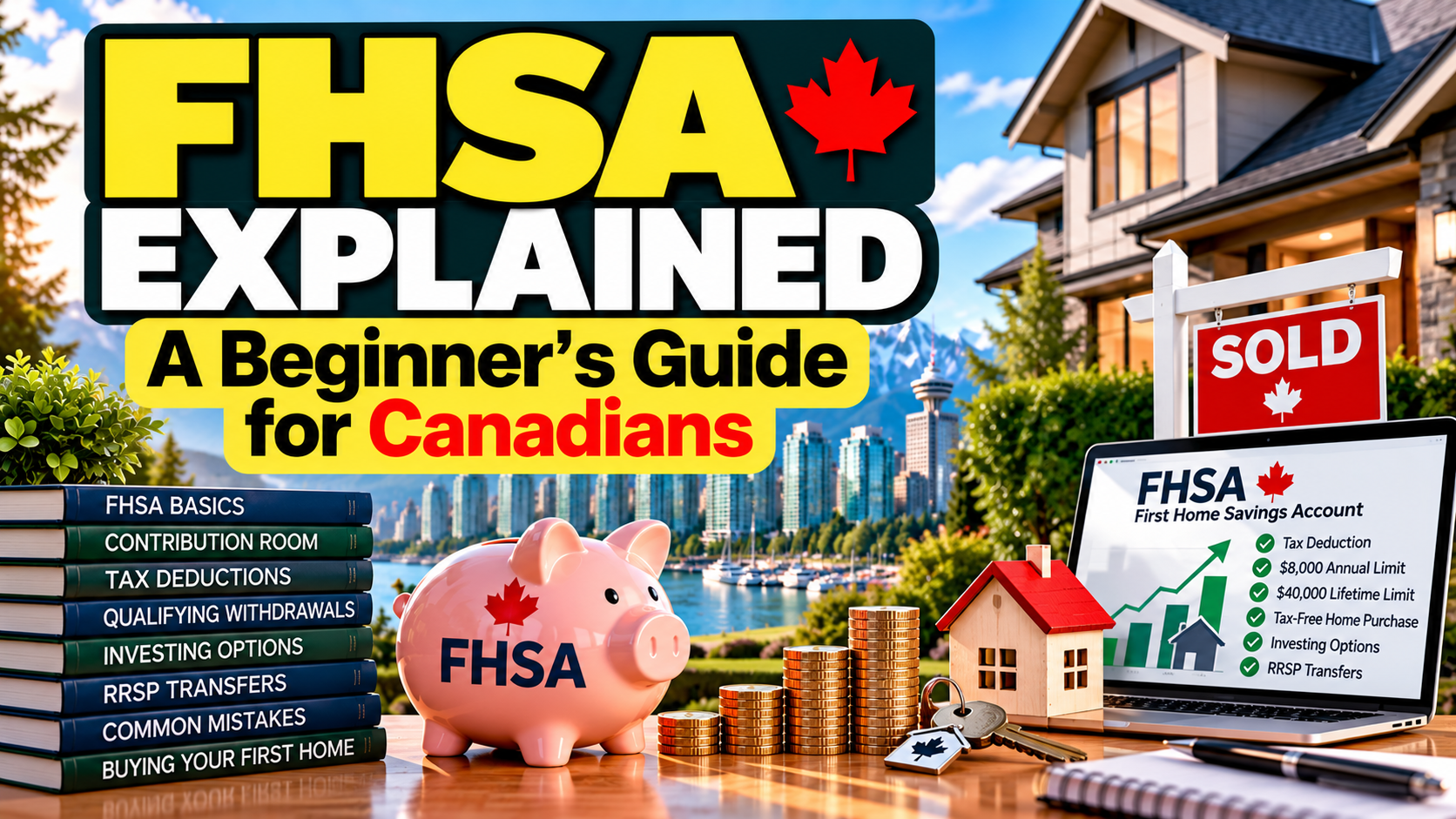
FHSA Explained: A Complete Beginner’s Guide for Canadians
If you are saving for your first home in Canada, the First Home Savings Account (FHSA) can combine two valuable tax features: contributions can generally be deducted from your income, while qualifying withdrawals used to buy or build a qualifying home can generally be made tax-free.
That makes the FHSA different from both an RRSP and a TFSA. The RRSP is primarily designed for retirement savings, while the TFSA provides tax-free investment growth and withdrawals for a broad range of goals. The FHSA is specifically designed for eligible first-time home buyers.
This guide explains how FHSAs work, who can open one, how contribution room works, how the tax deduction works, what you can invest in, how qualifying withdrawals work, what happens if you do not buy a home, and how an FHSA compares with a TFSA and RRSP.
The rules below reflect current Canadian FHSA rules for 2026. Always verify your personal contribution room and eligibility with the Canada Revenue Agency (CRA) and your financial institution before making a contribution or withdrawal.
WHAT IS AN FHSA?
An FHSA is a registered account designed to help eligible Canadians save for a qualifying first home.
The account combines features associated with both an RRSP and a TFSA.
Like an RRSP:
• Eligible contributions can generally be deducted from your income.
• Contributions can potentially reduce your taxable income.
• RRSP funds can be transferred directly into an FHSA, subject to the FHSA rules.
Like a TFSA:
• Investment income and growth inside the account can generally accumulate without being taxed annually.
• Qualifying withdrawals used to purchase or build a qualifying home can generally be made tax-free.
The important distinction is that the FHSA is specifically intended for an eligible first-time home buyer saving for a qualifying home in Canada.
WHO CAN OPEN AN FHSA?
To open an FHSA, you generally need to meet several conditions when you open the account.
You must:
• Be a resident of Canada.
• Meet the applicable minimum age requirement in your province or territory.
• Generally be 71 or younger at the end of the year in which you open the FHSA.
• Be a first-time home buyer under the FHSA rules.
The first-time home buyer definition is important.
For the purpose of opening an FHSA, you generally cannot have lived in a qualifying home that you owned or jointly owned during the current calendar year before opening the account or during the preceding four calendar years.
If you have a spouse or common-law partner when you open the account, their home ownership can also affect your eligibility if you lived in a qualifying home that they owned or jointly owned.
This means that someone who previously owned a home may eventually become eligible to open an FHSA again if they satisfy the applicable first-time home buyer rules.
The first-time home buyer test for opening an FHSA is not exactly the same as the test for making a qualifying withdrawal.
Source: Canada Revenue Agency.
HOW MUCH CAN YOU CONTRIBUTE TO AN FHSA?
The standard FHSA limits are:
Annual limit: $8,000
Lifetime limit: $40,000
The $40,000 lifetime limit generally applies to the total amount of contributions and certain RRSP-to-FHSA transfers.
Your available FHSA participation room depends on your individual circumstances.
One important point is that simply being eligible to open an FHSA does not automatically mean that you can contribute $40,000 immediately.
For example, if you open your first FHSA in 2026, your initial annual participation room is generally $8,000.
You cannot simply deposit $40,000 in the first year because the lifetime limit is $40,000.
Your available room accumulates according to the FHSA rules.
Source: Canada Revenue Agency.
HOW DOES FHSA CONTRIBUTION ROOM WORK?
FHSA contribution room works differently from TFSA room.
For the first year you open your first FHSA, your participation room is generally $8,000.
Unused room can carry forward, but the amount of carry-forward room that can be used is subject to specific FHSA rules.
The general concept is:
Year 1:
$8,000 available
If you contribute $3,000:
$5,000 remains unused.
In a later year, you may have your new $8,000 annual limit plus eligible carry-forward room.
However, FHSA room calculations can become more complicated when you have:
• Multiple FHSAs
• RRSP-to-FHSA transfers
• Previous unused room
• Excess contributions
• Designated transfers
• Qualifying withdrawals
Your FHSA participation room applies across all of your FHSAs.
Opening multiple FHSAs does not give you a separate $8,000 limit for each account.
For example, if you have two FHSAs and $8,000 of total participation room, you cannot contribute $8,000 to each account.
Your combined contributions and applicable transfers must remain within your available participation room.
Source: Canada Revenue Agency.
WHAT IS THE 2026 FHSA LIMIT?
For 2026, the standard annual FHSA limit is $8,000.
The lifetime FHSA limit is $40,000.
These limits apply to the FHSA system rather than giving you $8,000 of room for every FHSA you open.
For example:
FHSA #1: $4,000
FHSA #2: $4,000
Total: $8,000
If you have $8,000 of available participation room, that would use the full amount for the year.
CAN YOU CARRY FORWARD UNUSED FHSA ROOM?
Yes, but the carry-forward rules are different from simply accumulating unlimited annual room.
FHSA carry-forward room can generally be used in a later year, subject to the applicable limits.
For example, suppose you open an FHSA and contribute only $3,000 during your first year.
Some unused room may be available in a later year.
However, FHSA carry-forward calculations are subject to specific CRA rules, including limits on the amount of carry-forward room that can be used.
Do not assume that unused FHSA room works exactly like TFSA contribution room.
Always check your actual FHSA participation room before contributing.
Source: Canada Revenue Agency.
ARE FHSA CONTRIBUTIONS TAX-DEDUCTIBLE?
Generally, yes.
Eligible FHSA contributions can generally be deducted from your income when you file your tax return.
For example, suppose you contribute $8,000 to an FHSA and are eligible to claim the full contribution as a deduction.
The deduction can reduce the amount of income on which you pay tax.
The actual tax savings depend on your individual taxable income, province or territory, other deductions, credits and overall tax situation.
An $8,000 FHSA contribution does not mean that you automatically receive an $8,000 tax refund.
Instead, the contribution may reduce taxable income, which can reduce the amount of income tax you owe.
The CRA determines the amount that can be deducted based on your FHSA contribution history and applicable limits.
Source: Canada Revenue Agency.
WHEN SHOULD YOU CLAIM AN FHSA DEDUCTION?
An FHSA contribution does not necessarily have to be deducted in the same year you make it.
Eligible FHSA contributions can generally be carried forward and deducted in a future tax year, subject to the rules.
This can provide flexibility.
For example, someone with relatively low taxable income in one year might decide not to claim the entire available deduction immediately.
A future year with higher taxable income could potentially provide greater value from the deduction.
However, the best timing depends on your personal tax situation.
The important distinction is:
Contribution:
Money deposited into the FHSA.
Deduction:
The amount you choose and are eligible to claim against income on your tax return.
These are related but are not exactly the same thing.
WHAT HAPPENS TO INVESTMENT GROWTH INSIDE AN FHSA?
An FHSA can hold investments that qualify under the registered-account rules.
Depending on the financial institution and account type, eligible investments can include:
• Cash
• Savings deposits
• GICs
• Government and corporate bonds
• Mutual funds
• ETFs
• Stocks and other securities listed on designated stock exchanges
The investment options available depend on the specific FHSA provider.
If investments increase in value inside the FHSA, the growth can generally accumulate without annual taxation while it remains inside the account.
This makes the FHSA more than simply a savings account.
It can also function as an investment account for eligible first-time home buyers with an appropriate time horizon and risk tolerance.
SHOULD YOU INVEST YOUR FHSA MONEY?
That depends primarily on when you expect to need the money.
If you expect to buy a home very soon, protecting the money from a major market decline may be more important than pursuing higher potential returns.
If your home purchase is several years away, you may have more investment options to consider.
For example, someone saving for a home within a few months may prefer relatively conservative investments such as cash or certain GICs.
Someone with a longer time horizon may consider a diversified investment portfolio, depending on their risk tolerance.
There is no single FHSA investment strategy that works for everyone.
The closer you are to needing the money, the more important it becomes to consider the risk of a market decline immediately before the home purchase.
WHAT IS A QUALIFYING HOME?
A qualifying home is generally a housing unit located in Canada.
Examples can include:
• Single-family homes
• Semi-detached homes
• Townhouses
• Mobile homes
• Condominium units
• Apartments in duplexes, triplexes, fourplexes or apartment buildings
• Certain cooperative housing interests that provide ownership and an equity interest in a housing unit
A share in a cooperative that only gives you a right to tenancy does not qualify in the same way.
The property can be an existing home or a home being constructed.
Source: Canada Revenue Agency.
HOW DOES A QUALIFYING FHSA WITHDRAWAL WORK?
A qualifying withdrawal allows eligible FHSA funds to be withdrawn tax-free for the purchase or construction of a qualifying home.
There are several conditions.
Generally, you must:
• Meet the first-time home buyer requirements for a qualifying withdrawal.
• Have a written agreement to buy or build a qualifying home.
• Meet the required timing conditions.
• Be a resident of Canada during the applicable period.
• Intend to occupy the home as your principal place of residence within the required timeframe.
• Complete the required CRA form through your FHSA issuer.
The qualifying withdrawal process is therefore different from simply taking money out of a bank account.
You should confirm the requirements with your FHSA provider before requesting the withdrawal.
Source: Canada Revenue Agency.
CAN YOU WITHDRAW YOUR ENTIRE FHSA FOR A HOME?
Generally, yes, if the withdrawal qualifies under the FHSA rules.
There is no separate lifetime withdrawal limit for a qualifying home purchase in the same way that there is a lifetime contribution limit.
If you have accumulated $40,000 of contributions plus investment growth, the entire qualifying amount may potentially be used for your home purchase, provided the applicable requirements are satisfied.
For example:
Contributions: $32,000
Investment growth: $6,000
FHSA value: $38,000
If the withdrawal qualifies, the $38,000 can generally be withdrawn without income tax.
FHSA VS. TFSA
The FHSA and TFSA are both tax-advantaged accounts, but they serve different purposes.
FHSA:
Primary purpose:
Saving for a qualifying first home
Contributions:
Generally tax-deductible
Investment growth:
Generally tax-free while inside the account
Qualifying home withdrawal:
Generally tax-free
Lifetime contribution limit:
$40,000
TFSA:
Primary purpose:
Flexible tax-free saving and investing
Contributions:
Not tax-deductible
Investment growth:
Generally tax-free
Withdrawals:
Generally tax-free
Contribution room:
Based on annual limits and accumulated unused room
The FHSA has a specific home-buying purpose.
The TFSA is more flexible and can be used for many financial goals.
FHSA VS. RRSP
The FHSA and RRSP both allow eligible contributions to reduce taxable income, but their purposes differ.
FHSA:
Designed for eligible first-time home buyers
Contributions generally deductible
Qualifying home withdrawals generally tax-free
$40,000 lifetime FHSA limit
RRSP:
Primarily designed for retirement savings
Contributions generally deductible
Regular withdrawals generally taxable
Home Buyers’ Plan may allow an eligible RRSP withdrawal for a qualifying home purchase, subject to its own rules
The FHSA therefore has a particularly useful combination:
Tax deduction when contributing
Potentially tax-free withdrawal when buying a qualifying home
CAN YOU TRANSFER MONEY FROM AN RRSP TO AN FHSA?
Yes, direct transfers from an RRSP to an FHSA are permitted under specific rules.
However, an RRSP-to-FHSA transfer is not the same as making a new FHSA contribution.
Most importantly, a direct RRSP-to-FHSA transfer is generally not tax-deductible.
The transfer also uses available FHSA participation room.
For example, if you have $8,000 of FHSA participation room and directly transfer $5,000 from an RRSP, that transfer can use $5,000 of your available FHSA room.
You would generally have $3,000 of remaining room for other contributions or applicable transfers for that year.
The details can become complicated, particularly when transfers occur across multiple years.
Check your available FHSA room before making an RRSP transfer.
FHSA VS. THE RRSP HOME BUYERS’ PLAN
The FHSA and RRSP Home Buyers’ Plan can both be used in connection with buying a first home, but they operate differently.
FHSA:
• Contributions can generally be tax-deductible.
• Qualifying withdrawals can generally be tax-free.
• Investment growth can accumulate tax-free within the account.
• Lifetime FHSA limit is $40,000.
Home Buyers’ Plan:
• Uses money already held in an RRSP.
• Allows eligible individuals to withdraw qualifying amounts under the HBP rules.
• Withdrawn amounts generally have to be repaid to the RRSP over time.
• The current HBP withdrawal limit is $60,000.
The two programs can potentially be used as part of the same home-buying plan when a person meets the applicable requirements.
The HBP is not the same as an FHSA withdrawal.
The tax treatment and repayment requirements are different.
WHAT HAPPENS IF YOU DO NOT BUY A HOME?
Not buying a home does not necessarily mean the money in your FHSA is lost.
If you reach the end of your FHSA participation period without making a qualifying withdrawal, you may generally be able to transfer the FHSA directly to an RRSP or RRIF on a tax-deferred basis, subject to the applicable rules.
A direct transfer can generally occur without using your available RRSP deduction room.
This is an important feature because it provides a potential alternative if your plans change.
For example:
You open an FHSA.
You contribute and invest for several years.
You ultimately decide not to buy a home.
Instead of simply withdrawing the money and creating a taxable withdrawal, you may be able to transfer the FHSA directly into an RRSP or RRIF, subject to the rules.
The funds would then be subject to the normal RRSP or RRIF rules.
WHAT IS THE FHSA PARTICIPATION PERIOD?
Your maximum participation period begins when you open your first FHSA.
It ends on December 31 of the year in which the earliest of these events occurs:
• The 15th anniversary of opening your first FHSA
• You turn 71
• The year following your first qualifying withdrawal
This means that opening an FHSA starts an important clock.
You should understand the participation period before opening an account, particularly if you are not currently planning to buy a home soon.
Source: Canada Revenue Agency.
WHAT HAPPENS WHEN YOUR FHSA PARTICIPATION PERIOD ENDS?
Before your FHSA participation period ends, you generally need to deal with the remaining assets.
Depending on your situation, you may be able to:
• Make a qualifying withdrawal if you meet the requirements.
• Directly transfer the remaining property to an RRSP or RRIF on a tax-deferred basis.
• Withdraw the funds as a taxable withdrawal.
The CRA recommends closing FHSAs before the maximum participation period ends to avoid unintended tax consequences.
Source: Canada Revenue Agency.
WHAT INVESTMENTS CAN YOU HOLD IN AN FHSA?
Eligible FHSA investments are generally similar to investments permitted inside other registered accounts.
Depending on the account and institution, this can include:
• Cash
• GICs
• Government bonds
• Corporate bonds
• Mutual funds
• ETFs
• Stocks listed on designated stock exchanges
Real estate itself is generally not a qualified investment inside an FHSA.
The specific investment menu depends on the financial institution.
A self-directed FHSA may provide substantially more investment choices than a basic savings-style FHSA.
COMMON FHSA MISTAKES
1. Assuming you can contribute $40,000 immediately
The $40,000 figure is the lifetime limit, not the first-year contribution limit.
The standard annual limit is $8,000.
2. Confusing FHSA room with TFSA room
FHSA participation room follows its own rules.
Do not assume your TFSA contribution room tells you anything about your FHSA room.
3. Forgetting that all FHSAs share the same room
Opening multiple FHSAs does not create separate contribution limits.
Your participation room applies across your FHSAs.
4. Making an RRSP transfer without checking FHSA room
An RRSP-to-FHSA transfer uses FHSA participation room.
Check your available room before transferring.
5. Assuming every withdrawal is tax-free
Only qualifying withdrawals receive the special tax treatment.
Non-qualifying withdrawals can have tax consequences.
6. Ignoring the participation period
An FHSA does not remain open indefinitely.
Understand the deadline that applies to your account.
7. Investing home-purchase money too aggressively
If you need the money soon, a significant market decline could reduce your available down payment.
Investment risk should match your time horizon.
8. Assuming an FHSA is automatically better than a TFSA
The accounts have different purposes.
An FHSA is specifically designed for an eligible first home.
A TFSA is much more flexible.
9. Forgetting the first-time home buyer rules
The eligibility test considers your previous home ownership and, in certain circumstances, your spouse or common-law partner’s home ownership.
Check the rules before opening the account.
A SIMPLE FHSA STRATEGY FOR BEGINNERS
A basic FHSA strategy can be organized into five steps.
Step 1: Confirm eligibility
Make sure you meet the requirements for opening an FHSA.
Step 2: Open the account
Choose an FHSA provider that offers the investment choices and fees appropriate for your situation.
Step 3: Contribute consistently
If you have $8,000 of available room, you do not necessarily need to contribute the entire amount at once.
For example:
$8,000 annual room
Monthly contribution:
$8,000 ÷ 12 = approximately $667 per month
Automating contributions can make saving easier.
Step 4: Match investments to your timeline
The shorter your home-buying timeline, the more important capital preservation becomes.
A longer timeline may allow for a broader investment strategy.
Step 5: Prepare for the withdrawal
Before purchasing your home, confirm the qualifying withdrawal requirements and required documentation with your FHSA provider.
AN FHSA EXAMPLE
Imagine Sarah is eligible to open an FHSA in 2026.
She contributes:
2026: $8,000
2027: $8,000
2028: $8,000
2029: $8,000
2030: $8,000
Total contributions:
$40,000
Suppose her investments also grow by $5,000.
Her FHSA could then be worth approximately:
$45,000
If she purchases a qualifying home and meets all the conditions for a qualifying withdrawal, the entire eligible amount could potentially be withdrawn without income tax.
The investment return is not guaranteed, so the actual value could be higher or lower.
FHSA AND TFSA: CAN YOU USE BOTH?
Yes.
The accounts have different purposes.
Someone saving for a first home could potentially use:
FHSA for dedicated first-home savings
TFSA for additional flexible savings
RRSP for retirement savings and potentially the Home Buyers’ Plan
The appropriate combination depends on income, existing savings, time horizon, home-buying plans, retirement goals and available contribution room.
A useful way to think about them is:
FHSA = first home
TFSA = flexible tax-free wealth building
RRSP = retirement-focused tax-deferred savings
WHAT IF YOU HAVE ALREADY OWNED A HOME?
Previous home ownership does not automatically mean you can never use an FHSA.
The FHSA rules contain a four-year lookback period for determining first-time home buyer status.
For the purpose of opening an FHSA, the relevant test considers whether you lived in a qualifying home that you owned or jointly owned during the current calendar year before opening the account or the preceding four calendar years.
Your spouse or common-law partner’s home ownership can also matter when you open an FHSA.
Because the rules depend on specific dates and circumstances, someone who previously owned a home should check their eligibility carefully before opening an FHSA.
FREQUENTLY ASKED QUESTIONS
Is the FHSA tax-free?
The FHSA has two major tax advantages. Eligible contributions can generally be deducted from income, and qualifying withdrawals for a qualifying home can generally be made tax-free.
How much can I contribute to an FHSA in 2026?
The standard annual limit is $8,000, subject to your available participation room and the applicable rules.
What is the lifetime FHSA limit?
The lifetime FHSA limit is generally $40,000.
Can I invest in stocks inside an FHSA?
Yes, eligible securities listed on designated stock exchanges can generally be qualified investments. The exact investments available depend on your FHSA provider.
Can I buy ETFs in an FHSA?
Yes, eligible ETFs can generally be held in an FHSA.
Is an FHSA better than a TFSA?
They serve different purposes. An FHSA is specifically designed for an eligible first home, while a TFSA can be used for many different financial goals.
Can I transfer my RRSP to an FHSA?
You can generally make a direct transfer from an RRSP to an FHSA, subject to the FHSA rules and available participation room. The transfer itself is generally not tax-deductible.
What happens if I never buy a home?
Subject to the applicable rules, you may generally be able to transfer the FHSA directly to an RRSP or RRIF on a tax-deferred basis. Otherwise, a non-qualifying withdrawal may be taxable.
Can I have more than one FHSA?
Yes. However, your FHSA participation room applies across all of your FHSAs. Opening multiple accounts does not give you a separate contribution limit for each account.
How long can I keep an FHSA open?
Your maximum participation period generally ends on December 31 of the year in which the earliest of the following occurs: the 15th anniversary of opening your first FHSA, you turn 71, or the year following your first qualifying withdrawal.
FINAL THOUGHTS
The FHSA is a specialized Canadian registered account for eligible first-time home buyers.
Its main advantages are straightforward:
• Eligible contributions can generally reduce taxable income.
• Investments can grow within the registered account without annual taxation.
• Qualifying home withdrawals can generally be made tax-free.
• The lifetime contribution limit is $40,000.
• Unused room can potentially carry forward under the FHSA rules.
• Remaining funds can potentially be transferred to an RRSP or RRIF if you do not use them for a qualifying home.
The most important thing is to understand your eligibility, available participation room and home-buying timeline before contributing.
For someone who qualifies, the FHSA can be an important part of a broader Canadian financial system alongside a TFSA and RRSP.
SOURCES
Canada Revenue Agency — First Home Savings Account (FHSA)
https://www.canada.ca/en/revenue-agency/services/tax/individuals/topics/first-home-savings-account.html
Canada Revenue Agency — Opening your FHSAs
https://www.canada.ca/en/revenue-agency/services/tax/individuals/topics/first-home-savings-account/opening-your-fhsas.html
Canada Revenue Agency — Participating in your FHSAs
https://www.canada.ca/en/revenue-agency/services/tax/individuals/topics/first-home-savings-account/contributing-your-fhsa.html
Canada Revenue Agency — Withdrawals and transfers out of your FHSAs
https://www.canada.ca/en/revenue-agency/services/tax/individuals/topics/first-home-savings-account/withdrawals-transfers-out-your-fhsas.html
Canada Revenue Agency — Tax deductions for FHSA contributions
https://www.canada.ca/en/revenue-agency/services/tax/individuals/topics/first-home-savings-account/tax-deductions-fhsa-contributions.html
FINANCIAL DISCLAIMER
This article is provided for general educational and informational purposes only. It is not financial, investment, tax, legal or accounting advice and does not take into account your individual circumstances.
Canadian tax rules, contribution limits and registered-account regulations can change. Always verify current information with the Canada Revenue Agency, your financial institution or a qualified professional before making financial decisions.